Sunday just got better. From next week our door is open from 8 until the bread runs out, which, if we're honest, is usually around noon. Same ovens, same sourdough, slightly sleepier baker. See you Sunday.
- Formality
- Warmth
- Energy
DeepRit builds you a writer that knows how you sound, what you sell and what you've already said. Ask for a post, a proposal or a contract, and get something you can publish as it is. Bring your own AI key, and write without limits for $15 a month.
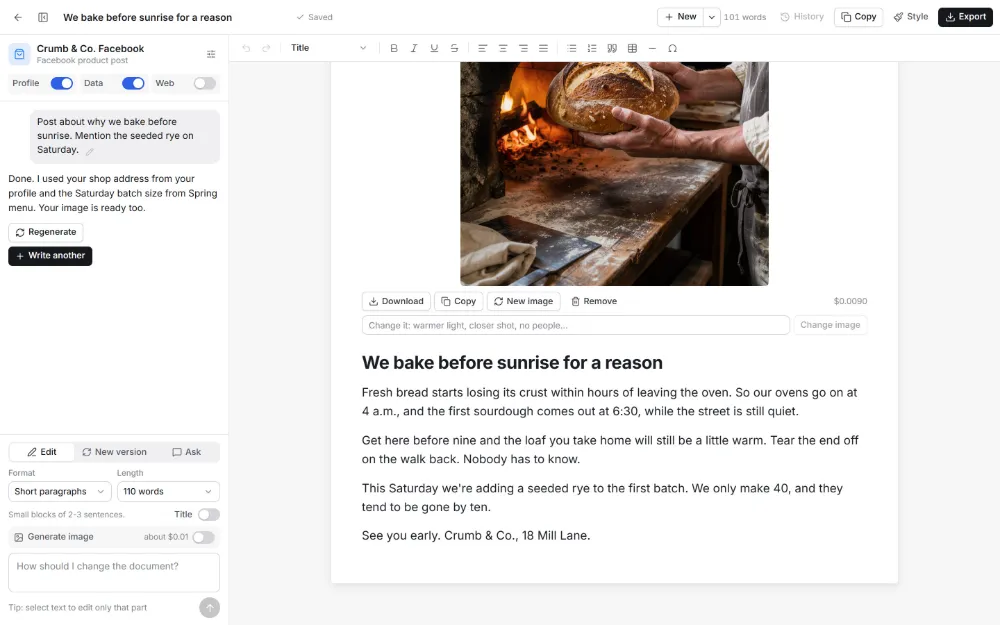
Most AI writing gives itself away by the second line. It doesn't know your prices, your customers or the way you end a sentence. So you spend the next twenty minutes fixing it. DeepRit starts at the other end. It learns you first, and writes second.
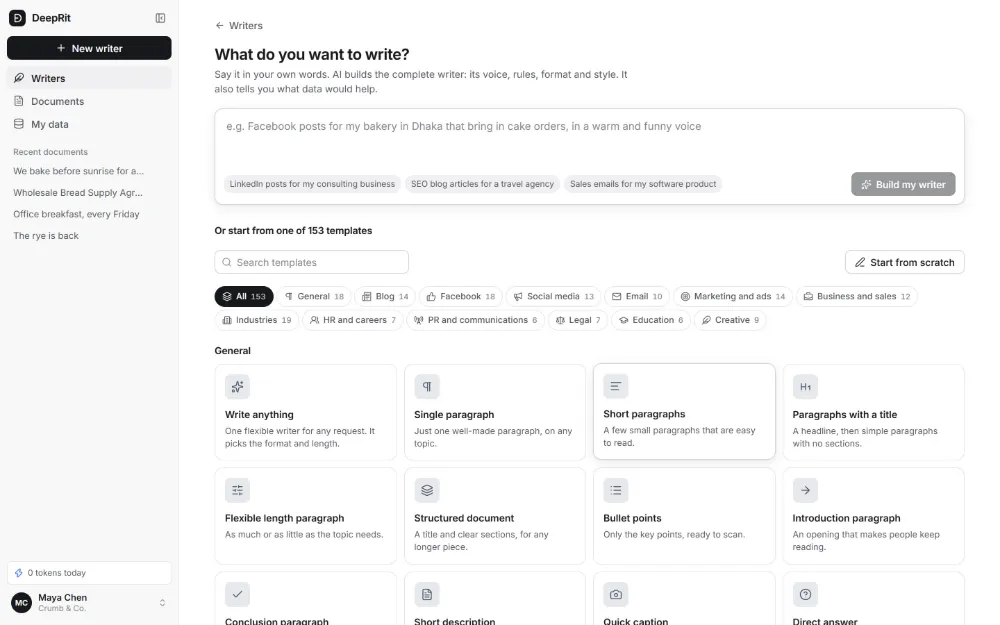
Type it the way you'd tell a colleague: "Facebook posts for my bakery that bring in cake orders, warm and a little funny." AI sets up the whole writer, its voice, rules, format and style, and tells you what data would help.
Rather pick? Start from one of 153 templates instead.
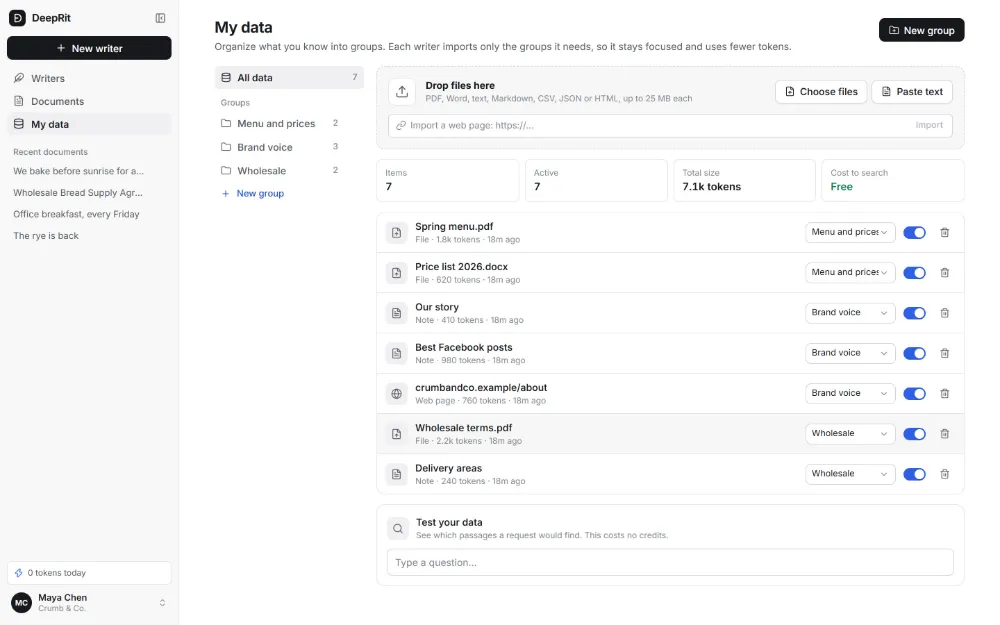
Add menus, price lists, past posts, web pages or plain notes, sorted into groups. Each writer imports only the groups it needs, so your contract writer never reads your Instagram captions.
Choose a format and a length, turn on an image if you want one, and send. What comes back is the piece itself. Copy it, export it, or ask for a change in plain words.
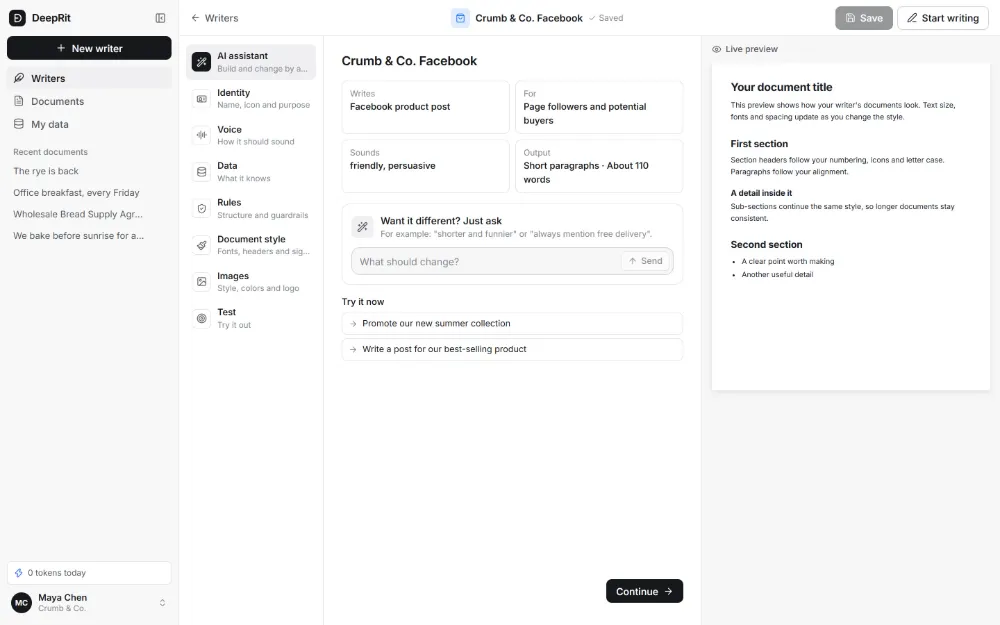
Every writer holds its own instructions, memory and house style. Change any of it by hand, or just tell the assistant what should be different.
The request “Tell people we're now open on Sundays.”
Sunday just got better. From next week our door is open from 8 until the bread runs out, which, if we're honest, is usually around noon. Same ovens, same sourdough, slightly sleepier baker. See you Sunday.
From next month, our Mill Lane office will open on Sundays between 10:00 a.m. and 2:00 p.m. Appointments can be booked in the usual way. Urgent matters will continue to be handled through your named solicitor.
No more skipping Sunday. We're open 7 to 1, starting this week. Open floor, no classes, loud music. Bring the friend who thinks Sunday is a rest day.
Examples written for this page, to show how voice settings differ. The businesses are made up.
Your profile holds who you are, your company, your offer and your audience. Your data holds the specifics. Switch either one off for a section, a writer or a single document, whenever it doesn't belong.
The seeded rye is back this Saturday, in the first batch out of the oven at 6:30. We only make 40. See you early at Crumb & Co., 18 Mill Lane.
Knows your name, your address and how you sound, plus the menu and the batch size.
Fourteen formats, a word count or flexible length, and a title if you want one. A free check afterwards holds the result to your choice. These previews are the same ones you'll see in the app.
No “here's your post”. No part labels. No blanks to fill in. If a detail is missing, it's left out and the writer tells you what to add. Contracts and other forms are the exception, and keep their fill-in fields on purpose.
Sure! Here's a Facebook post for your bakery:
Hook: Did you know fresh bread loses its crust within hours?
Body: At [Bakery Name], we are passionate about baking fresh bread every single day!
Call to action: Visit us today at [address]!
Would you like me to make it shorter?
Fresh bread starts losing its crust within hours of leaving the oven. So our ovens go on at 4 a.m., and the first sourdough comes out at 6:30.
Get here before nine and the loaf you take home will still be a little warm.
See you early. Crumb & Co., 18 Mill Lane.
Turn on Generate image when you ask, and it follows what the post says. Each writer has its own style, size, brand colors and logo. If a writer doesn't need images, switch them off for that writer.




All four were generated with the image model DeepRit uses, on one topic. Yours can use your own brand colors.
A contract shouldn't look like a blog post. Each writer has its own document theme, with fonts, headers, numbering, letterhead and signature blocks, and you can sign right on the page.
Also: modern, editorial, business letter, research report, press release, social post, resume and minimal. Export to PDF, Word, HTML or Markdown.
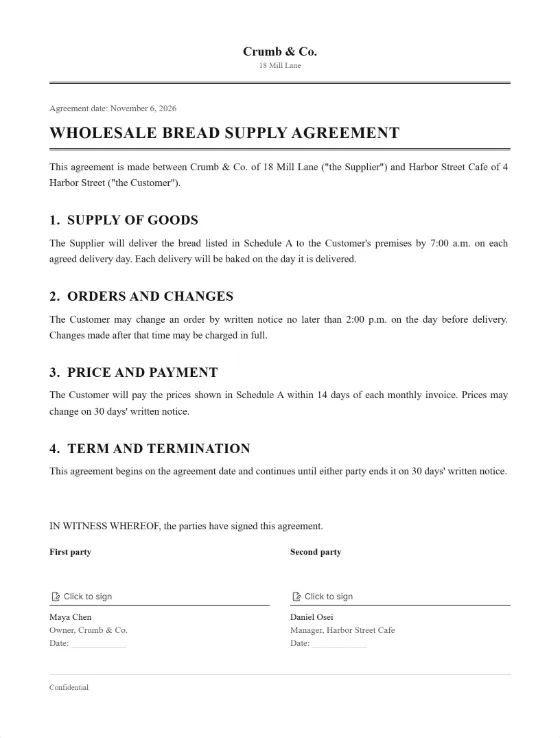
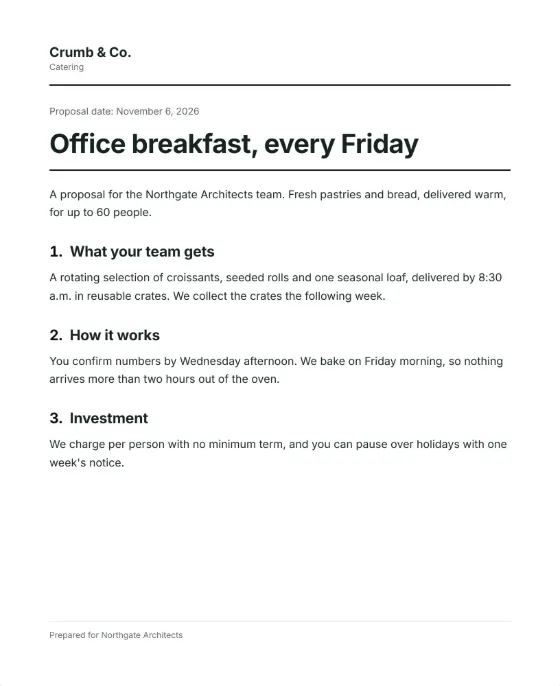
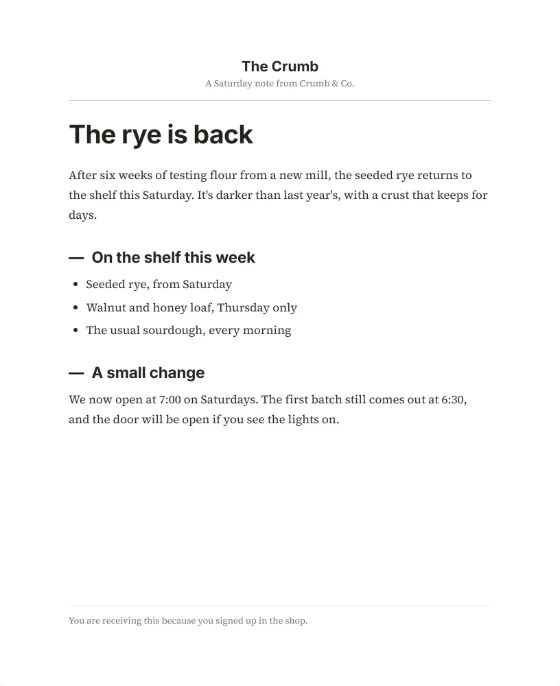
Whatever your industry, there's a starting point here that already understands the job. Every one can be changed.
No template by that name. Describe it in a sentence instead, and AI will build the writer for you.
You bring your own AI key, so your provider bills you directly, with no markup from us. DeepRit then does most of the work on your device, so that as little as possible reaches the AI.
Choose Eco, Balanced or Deep in Settings. Each message shows the tokens it used. See pricing.
Rules in the database let each account reach only its own writers, data, documents and images, whatever a request asks for.
The AI provider receives the passages picked for that one request. Your full library stays where it is.
Signing out clears your account from the browser, so the next person sees nothing of yours.
Export a full backup whenever you like, and delete everything from Settings when you want it gone.
No. Describe what you want in ordinary words. The writer already holds the instructions, so a request can be as short as “a post about Saturday's rye”.
It's told to leave out what it doesn't know and tell you what to add, instead of inventing a detail or leaving a blank. As with any AI, read what it wrote before you publish, especially anything drawn from the web.
Social posts, blogs, emails, ads, proposals, reports, job posts, press releases, contracts, lesson plans, stories and more. There are 153 templates across 13 categories, and you can describe anything else in a sentence.
Yes. Ask for the language in your request, or set it on the writer.
Treat them as a first draft for a qualified lawyer to review. Signatures place your mark on the document, but they aren't certified e-signatures.
Your request, the writer's settings, and the passages and profile facts that matched. Requests go through OpenRouter to the model provider. If you turn on Web, your request is also used as a search query.
No. DeepRit writes, and you decide what goes out. Copy or export your work, then publish it yourself.
Pro is $15 a month for unlimited use, 10 MB of data and up to 5 team members, with your own AI key. You can also start free with limited use and no card. See Pricing.
You add your own API key from OpenRouter, an AI service that connects to many models. Your requests run on that key, so OpenRouter bills you directly at its own rates, and we don't add a markup.
Yes. Add files, links and notes to your data, and paste a writing sample so a writer can learn your voice.